


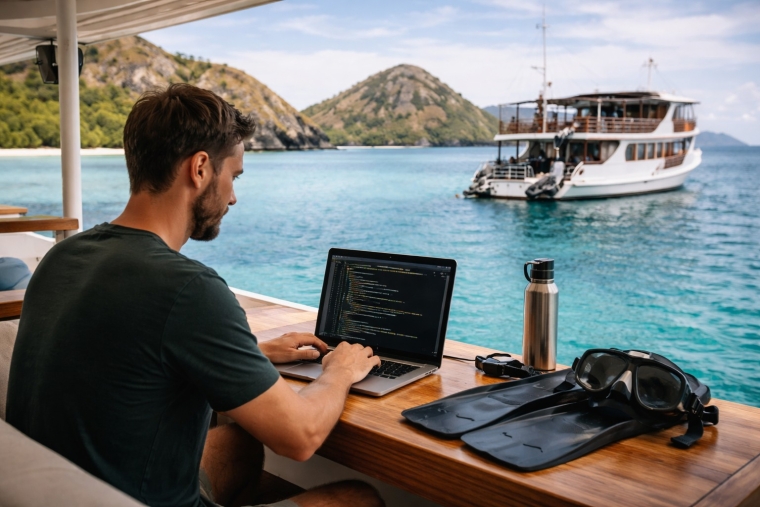
If you’re planning a build-cation in eastern Indonesia, a Komodo Island liveaboard and tour can be the rare kind of travel that genuinely supports focus: you wake up to quiet seas, move through a simple daily rhythm, and still get the kind of natural “wow” that resets your brain after a long sprint cycle.
I’m writing this with a hotel-manager lens, someone who’s spent years watching how different guests recover, connect, and perform when they’re away from notifications and meetings. For WordPress builders, SaaS engineers, product-minded founders, and anyone who enjoys turning messy inputs into clean systems, a liveaboard is basically an elegant environment design problem: constraints are clear, the schedule is predictable, and the feedback loop (sunrise → dive → work block → sunset) is immediate.


Why liveaboards work so well for “deep work” travelers
A liveaboard is not just transport; it’s a controlled workflow. There are fewer decisions to make each day, which reduces cognitive load the same reason, good developer tooling matters. On a boat, your defaults are set:
- You don’t commute. Your “office” is a shaded deck, a simple cabin, or a quiet corner with a breeze.
- The calendar is opinionated. Most days have a fixed cadence: meals, briefings, water sessions, rest.
- Distractions are naturally rate-limited. Connectivity can be patchy, and that’s a feature, not a bug.
For developers who live inside ticket queues and deployments, this environment can feel like switching from constant interrupts to batch processing. You can still ship, just in a calmer mode.
The itinerary mindset: treat your trip like a product roadmap
Before you think about gear or photo spots, define your “MVP outcomes.” On many trips, people try to optimize for everything and end up exhausted. Instead, choose a primary objective and let everything else be secondary.
Possible objectives:
- Diving-first (skill building, marine life encounters, underwater practice)
- Scenery-first (viewpoints, beaches, light hiking, drone-free mindfulness)
- Recovery-first (sleep, reading, journaling, low-intensity snorkeling)
- Work-first (a realistic number of offline work blocks)
Once you set the objective, you can choose a schedule that matches your energy. A classic mistake among high performers is assuming vacation stamina equals work stamina. It doesn’t.
If diving is your priority, be honest about whether you want a high-activity plan with multiple water sessions per day, because Komodo liveaboard diving can be both spectacular and physically demanding, depending on sites and conditions.
A practical note on diving in Komodo: beauty with responsibility
One reason experienced divers talk about this region with such respect is that the underwater environment can be dynamic. That dynamism is part of what makes it memorable, but it also rewards preparation and humility.
If you’re a developer, think of it like production reliability: you don’t fear complexity, you manage it. That means:
- Listen closely to briefings and don’t treat them as optional documentation.
- Be conservative with your limits, especially if you haven’t been in the water recently.
- Stay well-rested and hydrated. Dehydration, sun, and exertion are a classic “silent failure mode.”
- Choose comfort with buoyancy control. The best divers look calm because they’re stable, not because they’re rushing.
You don’t need to be ultra-technical to be safe; you just need to be consistent. That’s a familiar principle for anyone who’s ever maintained a stable codebase.
“Luxury” done right: comfort as a performance tool, not a flex
Let’s talk about Komodo Island liveaboard luxury in a non-salesy way: comfort isn’t about showing off, it’s about creating the conditions for recovery and clarity. When guests ask me what matters most, it’s rarely the most glamorous feature. It’s usually one of these:
- Good sleep (quiet cabin, decent ventilation, comfortable bedding)
- Good food timing (steady energy, not heavy meals that crash you)
- Dry space (a place to hang gear and keep devices safe)
- Friendly, calm crew culture (psychological safety matters more than people admit)
- Simple logistics (no daily re-packing, no repetitive admin)
If you’re planning to write, code, or even just think well, luxury is the absence of friction. It’s the same reason you invest in a clean CI pipeline: not to brag, but to prevent avoidable failures.
How to pack like a developer (minimal, modular, resilient)
Overpacking is the travel equivalent of adding dependencies you don’t need. Aim for a small, composable kit that supports your main objective.
For work blocks:
- One reliable device + charging setup (don’t rely on a single cable)
- Offline docs or synced notes
- A lightweight keyboard if you write a lot
- Earplugs (the unsung hero for sleep and focus)
For water and sun:
- Reef-safe sun protection strategies (cover up rather than constantly reapplying)
- A light layer for wind and evening chill
- Dry bag for electronics
- Simple motion-sickness plan if you’re sensitive
For content creators and WordPress builders:
- Capture notes like you’d capture requirements: short, structured, and timestamped.
- Draft offline in plain text or a distraction-free editor, then publish later.
- Treat photos like assets, label them, and create a small workflow so you don’t return with a chaotic folder dump.
If you build sites for clients, you’ll appreciate coming home with clean material: story angles, short reflections, and visuals that don’t require hours of sorting.

Designing your day: a sustainable rhythm that doesn’t burn you out
A liveaboard day can feel like a perfectly scheduled conference until you realize you’re doing physical activity in the heat. The best trips I’ve seen follow a simple rule: protect your recovery window.
A developer-friendly rhythm looks like:
- Morning: low-friction start, short planning note, first water session if you’re doing it
- Late morning: one focused work block (60–120 minutes), offline if possible
- Afternoon: exploration (snorkel/dive/shore), then rest
- Evening: light review: what you saw, what you learned, one idea worth keeping
The goal isn’t to cram productivity into paradise. The goal is to return with a calmer nervous system and a few high-quality insights, technical or personal.
Respect is part of the experience
When people visit Komodo National Park, the most meaningful experiences come from acting like a guest, not a consumer. That means:
- Keeping a distance from wildlife and following the ranger’s guidance
- Avoiding “touching the reef” behaviors while snorkeling or diving
- Being mindful of noise and waste
- Valuing the crew’s knowledge and local expertise is not “extra,” it’s core
If you build software, you already understand stewardship: systems degrade when users treat them carelessly. Nature is no different.
Closing thought: what you bring back is the real deliverable
The best Komodo liveaboard trips don’t just give you photos. They give you a new default pace. For many developers, that’s the most valuable outcome: you can focus longer, sleep deeper, and make cleaner decisions.
If you approach the trip the way you approach sound engineering, clear goals, sensible constraints, and respect for the system, you’ll get something rare: adventure that doesn’t scatter your attention, and rest that actually restores you.